
How to deploy your own RoboBus
Four stops, four decisions, from the first demo ride to everyday public service. A complete engineering and capital blueprint based on the turnkey operational framework by NIT Institute and PiX Moving.
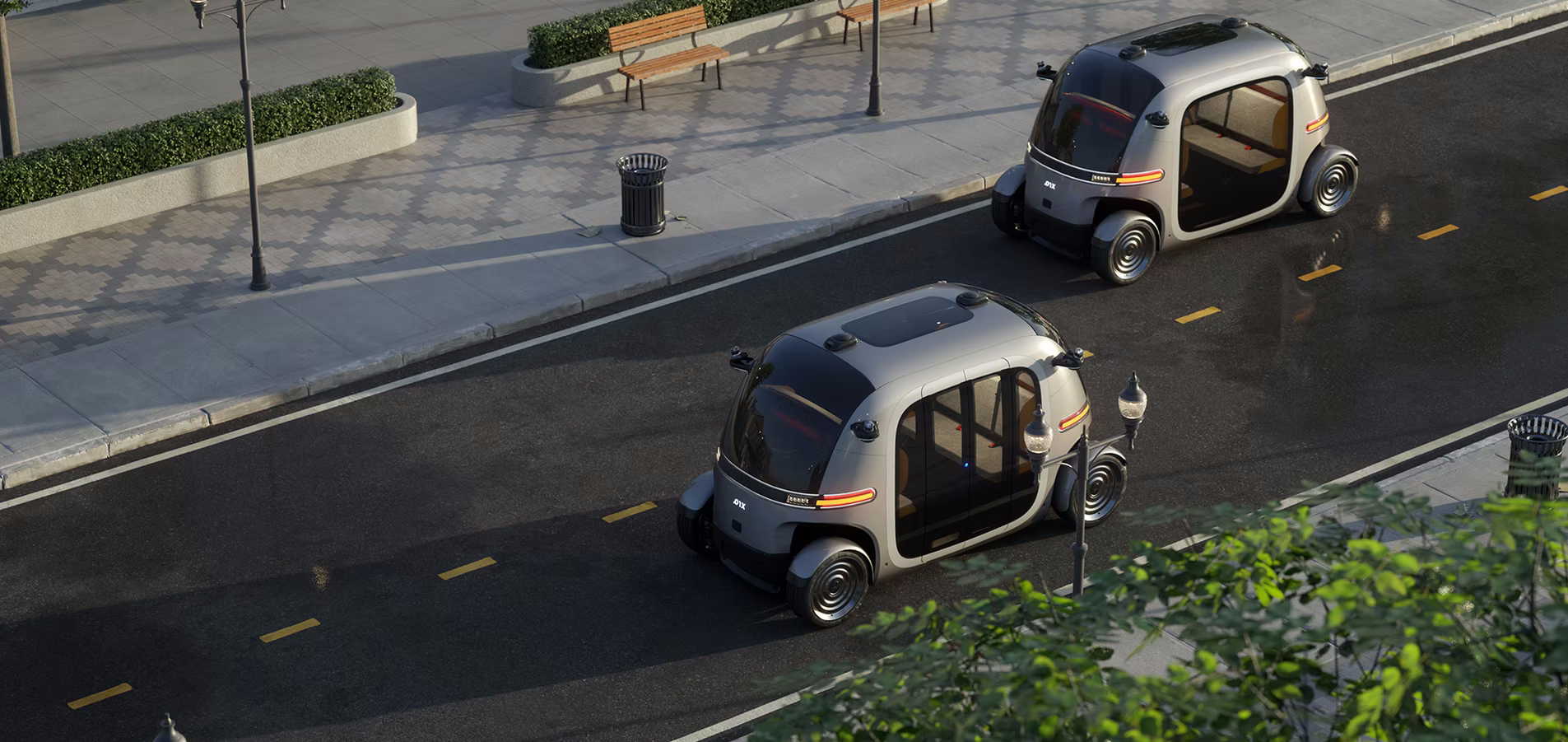
“A RoboBus isn't bought like a car: it is a road you build, stop by stop, decision by decision.”
Deploying an autonomous shuttle is not an off-the-shelf procurement. It is a structured engineering journey where every stage systematically de-risks technical feasibility, regulatory compliance, and capital investment. Autonomous transit is reaching a decisive turning point, moving away from speculative closed-track demonstrations into dependable, revenue-generating commercial operations.
The RoboBus is an industrial piece of equipment engineered to operate inside a strict operational design domain. Demo rides don't prove commercial viability, multi-year service loops do. Historically, automated transit pilots get bogged down because no single party owns the outcome from vehicle hardware to local road permits. NIT Institute and PiX Moving take complete operational responsibility, packaging the PiX Level 4 platform, safety engineering, and everyday fleet management into one contract.
Governance Architecture: Three Parties, One Contract
Fragmented consortiums with misaligned responsibilities are the primary reason autonomous trials fail to reach production. The deployment architecture aligns three stakeholders under one clear governance structure.
NIT Institute acts as the single contract partner and certified operator. NIT manages operational use cases, safety and cybersecurity cases, operating permits, engineer training, high-definition mapping, attendant staffing, and daily revenue service.
The vehicle manufacturer, PiX Moving, builds and supplies the Level 4 drive-by-wire RoboBus. PiX provides the remote operations control room, continuous OTA software updates, and remote technical support, all orchestrated directly through NIT.
You, the Site Owner, provide the site transit goals, route access, local rules, and passenger demand data. You also supply a sheltered charging depot with industrial power and execute sign-offs at each decision gate.
Stop 1 • The Use: Three Proven Operational Models
A RoboBus service succeeds only when tailored to a clear, repeatable transit use case. Globally, three primary applications have demonstrated viable demand.
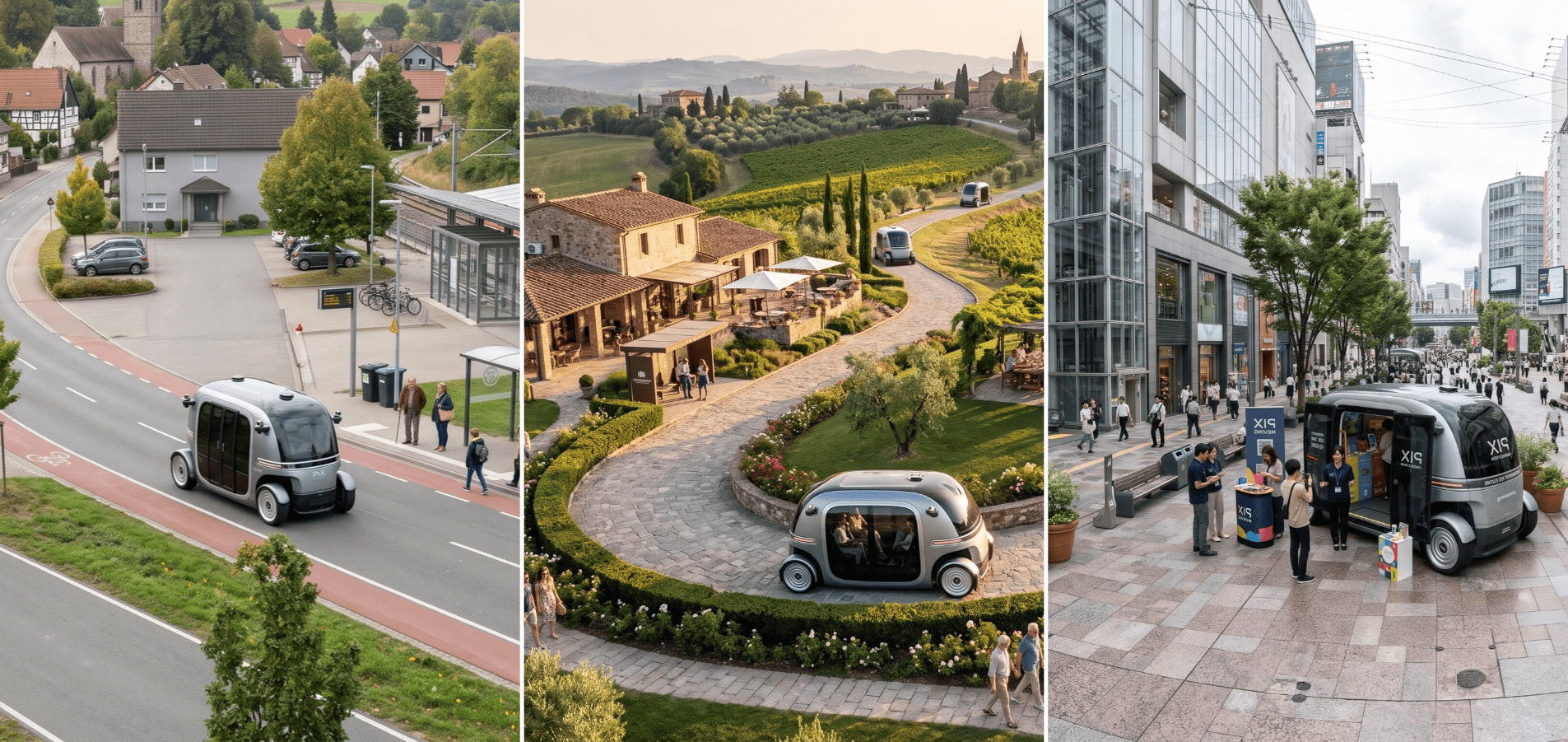
Last-Mile Public Transit connects rural villages or suburban edges to regional rail hubs, solving mobility deserts for schoolchildren, the elderly, and non-drivers. This application is already operating in Germany, Belgium, and Austria, with deployments expanding across Europe.
Experience Loops provide a private circulating loop in an amusement park, resort, or campus. The vehicle serves as a moving venue offering scenic stops, wine tastings, or exhibits, as proven by WanderLoop in China. In this model, you don't sell a trip, you sell a moment. The vehicle is the stage, and the content is the park.
Mobile Brand Tours function as an experiential promotional stand on wheels. The bus carries brand livery along high-footfall corridors while the host acts as an active ambassador, an application successfully deployed in Japan.
Stop 2 • Where Can It Drive? The Regulatory Fork
Operating an automated vehicle requires two distinct permissions: approval for the vehicle platform to be on the road, and an operating permit for the specific route and operating company. The deployment path branches fundamentally based on property ownership.
Private Grounds represent the fast track. Within resorts, university campuses, corporate tech parks, or private events, the site owner's rules and commercial liability insurance apply. No highway ministry approvals or road homologation are required, making this the fastest way to start operations.
Public-Road Links require full permitting. Any public road crossing necessitates both vehicle type-approval and a formal operating permit, alongside a trial permit for testing. In France, this route is governed by Decree 2021-873 under STRA supervision, requiring independent technical inspection audits and trial permits.
To build the Stage B4 Safety Case, technical evidence preparation is mapped directly to regulatory compliance targets:
- ISO 26262 (Functional Safety for electromechanical automotive systems) provides the evidence base for UN R185 (Automated Driving Systems international type approval).
- ISO 21434 (Vehicle Cybersecurity across development and production) maps to UN R155 Cyber Security Management Systems and the EU Cyber Resilience Act (CRA).
- ISO 21448 / SOTIF (Safety of the Intended Functionality under operational edge cases) satisfies national transit certifications, including French Decree 2021-873.
- ISO 8800 (Safety validation for AI and Machine Learning road models) provides the documentation required for formal clearance by independent technical inspection bodies.
* On private grounds, these standards guide the safety case; on public transit links, compliance is legally mandatory.
Stop 3 • The Technology: Eyes, Orientation, and Reflexes
PiX Moving engineered this RoboBus specifically for Level 4 autonomy: on its defined route, it drives itself. The hardware stack coordinates three essential capabilities:
Eyes (360° Vision): Heterogeneous sensors ensure complete perimeter awareness under varying weather conditions. LiDARs generate a continuous 3D point cloud mesh. Surround HDR cameras read road markings, traffic lights, signs, and pedestrians. A forward 4D radar pierces rain, dust, and thick fog to track vehicles far ahead. Ultrasonic sensors manage the close-range obstacle envelope right around the bus body. Together, they create a redundant, 360-degree environmental model.
Position (Centimeter Accuracy): Consumer GPS is inadequate for autonomous transit. The bus combines three independent data streams: multi-frequency GNSS satellite constellations for a baseline, a ground RTK base station providing real-time differential corrections, and a 3D vector map acting as a centimeter-precise semantic digital twin of the route.
Reflexes (Redundant Drive-by-Wire): The chassis features a fully electronic drive-by-wire system with dual-redundant actuation. It utilizes independent electronic front and rear double steering, along with two isolated electro-hydraulic braking circuits. If one part fails, another takes over. Finally, direct-wired emergency stop buttons inside the passenger cabin allow passengers or staff to halt the vehicle instantly.
A Deep Dive into Level 4 Autonomous Transit
In a national television interview on RTS (Šarenica), project lead Prof. Dr. Milan Bjelica and engineer Anja Simić discuss the practical engineering and deployment reality of the RoboBus. They unpack why transitioning from a student prototype to a road-certified vehicle demands strict safety standards, how 360° sensor fusion (LiDAR, radar, and cameras) navigates real-world obstacles, and how remote tele-operations enable a single control center to oversee an entire fleet.
If you are interested in the engineering details, safety procedures, and practical steps behind bringing the RoboBus to real routes, watch the full interview below:
Stop 4 • Service Execution & Total Cost of Ownership (TCO)
A shuttle that stops and remains blocked at every unmapped obstacle is safe, but provides zero transit utility. Stage 1 deployments operate on a hybrid supervised operating model.
The vehicle drives autonomously, but an onboard hospitality attendant greets riders, assists mobility-impaired passengers, ensures cabin safety, and manages depot charging. If the bus encounters an ambiguous obstruction, such as roadworks or an illegally parked truck. It halts safely and calls the PiX Control Room. A remote supervisor reviews camera feeds, validates an approved bypass path, and authorizes the vehicle to proceed via tele-operation.
Master Engineering Roadmap: The Phased Deployment Highway
The master deployment flows across three sequential phases, supported by a parallel readiness track. Milestones marked as Decision Gates indicate where site owners execute mandatory go/no-go reviews.
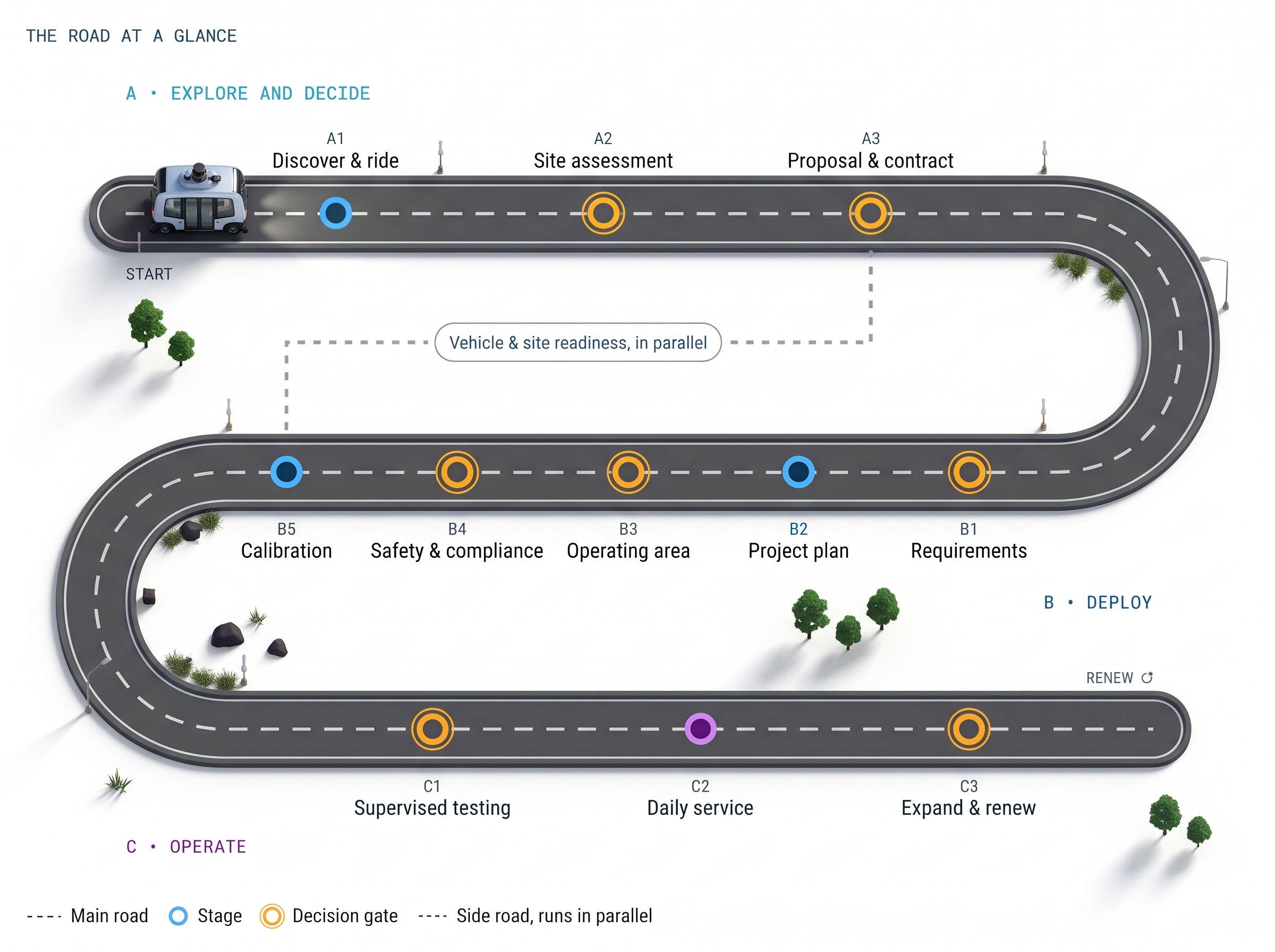
Phase A (Explore and Decide): The journey begins with A1 (Discover & Ride), featuring a discovery briefing about transit goals, site topology, and season timelines, alongside a demo ride on the PiX shuttle. A2 is the Site Assessment (Gate), which includes a route check against vehicle limits and a real break-even calculation based on visitor numbers and current transit expenditure. A3 is the Turnkey Contract (Gate), establishing the single master SLA contract, operator insurance, and vehicle lock-in.
Track R (Parallel Vehicle & Site Readiness): Running concurrently from contract signing, PiX manages vehicle manufacturing, logistics, overseas shipping, and customs. Concurrently, the site owner constructs a sheltered charging depot with industrial power, while NIT installs the RTK base station, audits 4G/5G connectivity, and handles registration.
Phase B (Deploy): B1 establishes Requirements (Gate), evaluating gradient fit, site privacy rules, and fixing the private vs. public approval route. B2 formulates the Project Plan, tailoring safety and cybersecurity processes and setting up the software stack using PiX interface data. B3 defines the Operating Area (ODD) (Gate) across six structural layers and signs off the centimeter-accurate 3D vector map. B4 is the Safety & Compliance step (Gate), generating structured evidence across four ISO standards to achieve safety case permit approval. Finally, B5 covers on-site Deployment Calibration, including sensor alignment and software boot checks on the physical route.
Phase C (Operate & Scale): C1 initiates Supervised Testing (Gate), advancing from closed-area trials to route runs with a safety driver, ensuring acceptance criteria are met for the go-live decision. C2 is Daily Service, featuring the onboard attendant, remote tele-operations via the PiX control room, and regular service reports. C3 represents Expand & Renew (Gate), where business performance is reviewed against the original A2 financial plan, enabling ODD expansion and next-season fleet scaling.
Total Cost of Ownership (TCO) Comparison
Hourly operating cost breakdown: Conventional human-driven transit bus vs. turnkey autonomous fleet (Model based on typical Western European municipal transit labor rates and Stage A2 amortization benchmarks):
~€82 / Vehicle-Hour
~€34 / Vehicle-Hour (-58%)
By shifting driver payroll into depreciable hardware and software capital expenditure, unit economics invert. At Stage C3, performance is reviewed against the original Stage A2 financial plan. This enables sponsors to expand service hours, add vehicles, and capture positive unit margins across routes that previously ran at steep deficits.